
Finding an affordable place to live in Central Florida can feel impossible for thousands of families, as caregivers, seniors on fixed incomes and working parents are being priced out of the communities they serve, forced farther from jobs and support networks.
A new National Low Income Housing Coalition report shows why: The Orlando-Kissimmee-Sanford area has just 19 affordable homes for every 100 extremely low-income renters, ranking it the sixth-hardest housing market in the nation for those most in need.
In addition, population surges, soaring rents and years of underbuilding have left the region’s housing crisis not just persistent, but systemic.
“If I’m company XYZ and I’m thinking about relocating from the Midwest to Orlando and bringing 1,000 employees, if our median home price is significantly higher or we don’t have great opportunities for attainable housing for the lower-level employees, they’re going to pass us over and move on to the next place,” said Seminole County Property Appraiser David Johnson.
“From an economic development perspective, you’ve got to have a nice mix of housing.”
To talk about the current state of the residential market in Central Florida, Orlando Business Journal convened a roundtable of industry experts to share their insights on the region’s ongoing need for affordable housing as part of that mix.
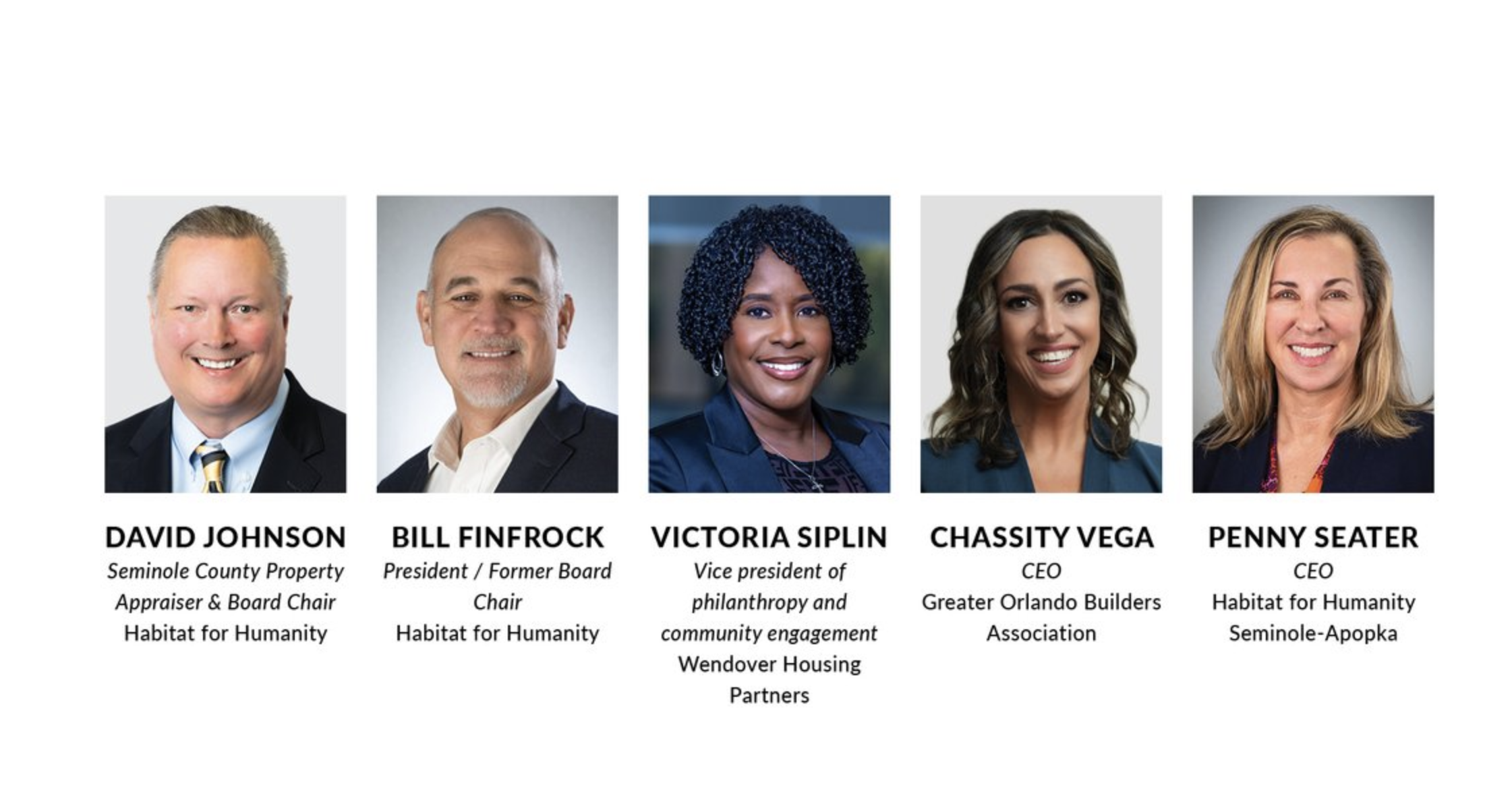
Roundtable participants included Johnson; Bill Finfrock, president of Finfrock and former board chair of Habitat for Humanity Seminole-Apopka; Victoria Siplin, vice president of philanthropy and community engagement at Wendover Housing Partners; Chassity Vega, CEO of the Greater Orlando Builders Association; and Penny Seater, CEO of Habitat for Humanity Seminole-Apopka.
Here’s what they had to say about what is and isn’t working right now, misconceptions and the stigma connected with affordable housing, and why addressing the issue is a smart economic decision.
WHY AFFORDABLE HOUSING IS AN ECONOMIC IMPERATIVE
Affordable and attainable housing is more than a quality-of-life issue; it’s an economic driver that shapes workforce stability, business growth and the region’s competitiveness.
The 2025 Gap Report ranked the Orlando-Kissimmee-Sanford area as one of the nation’s most challenging markets for affordable housing, with tens of thousands of low-income renters unable to find a home that costs no more than 30% of their income.
This shortage forces many essential workers — from nurses and hospitality staff to teachers and tradespeople — to live far from their jobs, driving up commute times, infrastructure costs and employee burnout.
“We need people that take care of our aging parents and our young children,” said Seater, recalling the nurses who cared for her father while enduring 90-minute commutes each way.
“Could you be doing better if you didn’t have three hours out on the road?” she asked, pointing out that housing closer to jobs leads to better care, stronger companies and healthier communities.
In fact, long commutes are not just a personal burden, they’re an economic inefficiency.
Siplin noted that some tourism workers spend up to four hours a day on buses, which is “quality time you could be spending with your family.”
Locating housing near jobs reduces congestion, lowers road maintenance costs and keeps more disposable income circulating in local neighborhoods. Research shows that for every $1 spent on affordable housing construction, more than $3 in economic activity can be generated through wages, materials purchases and local spending.
Housing shortages also slow construction, creating a ripple effect as fewer active job sites mean less work for plumbers, electricians and other trades, which in turn shrinks the tax base and consumer spending, said Vega.
Additionally, affordable housing has measurable impacts on productivity and retention because resulting stability helps employees stay focused, lowers turnover and reduces absenteeism, studies show.
“You want an employee who wants to come to work and really work,” said Siplin. “You don’t want them sitting at their desk worried because their mind is somewhere else.”
Yet, more than half the region’s residents have less than $400 in savings — meaning even a small, unexpected expense could lead to eviction or doubling up with family, a form of hidden homelessness.
Finfrock cautioned that Central Florida’s continued growth depends on solving the housing gap before it follows the path of other major metros that stagnated.
“You think growing is hard? Try not growing,” he said.
CHALLENGES IN ADVANCING AFFORDABLE HOUSING
Even with the ongoing need for a better mix of rooftops, efforts to increase affordable housing in Central Florida face a complex web of challenges from funding gaps to public perception that make even well-intentioned projects difficult to realize.
Siplin said one of the most persistent barriers is a lack of dedicated funding. And without sufficient financial resources, projects stall before they can get off the ground.
Johnson added that infrastructure expenses alone can be prohibitive, and while innovative tools such a $1 million revolving fund for infrastructure improvement Habitat created in partnership with Seminole County have helped, they are rarely large enough to meet the scale of the problem.
In addition, “regulatory fees can significantly inflate costs — in some cases accounting for more than 25% of a project’s price tag,” added Vega. Labor shortages further constrain the ability to deliver units at affordable prices, she said.
And then there’s the issue of inconsistent political will, Siplin said: “You have those who ‘admire the problem.’ OK, then let’s get this done. Let’s be committed to this.”
Finfrock likened the process of getting even a market-rate apartment entitled to “putting on your combat helmet,” underscoring the contentious nature of land-use approvals. The supply-demand imbalance in Central Florida only heightens these tensions, he said.
While these are all significant challenges, another big issue is the need to change how the public views affordable housing. Both Siplin and Johnson stressed that many people misunderstand who affordable housing serves, often clinging to stereotypes and feeding NIMBY fears. In reality, these homes are for essential workers — teachers, health care professionals, bank employees — whose salaries no longer align with rising home prices.
Vega said that’s why she has shifted her language from “affordable” to “attainable” housing – to help ease stigma and gain broader community and political support.
Johnson agreed: “I think people don’t understand what we’re talking about when we talk about affordable housing. These are folks who work for the health care industry. They are people who work for the banks. They are people who work for the school system. There’s a stigma out there that these are people who are sitting at home eating bonbons and collecting a welfare check. That’s just not true. These are the people who make this community go.”
That’s why education is crucial for both residents and the community at large, said Vega, who cautioned against programs that simply “check the box” of homeownership without preparing families for ongoing maintenance and repair costs.
Seater agreed and said Habitat for Humanity’s approach includes robust homeowner education to protect investments, prevent foreclosures and build generational wealth.
“We want to make sure that family is set up for long-term successful home ownership and that it ends up being an asset they can pass down to their family.”
BEST PRACTICES FOR ADVANCING AFFORDABLE HOUSING
While the road to more affordable housing in Central Florida is steep, there are some strategies that have proven effective in bridging gaps and overcoming obstacles.
Siplin stressed the importance of engaging local elected officials, civic groups and churches early in the planning process. This early outreach helps to identify and address concerns before a project begins, building trust and smoothing approvals.
“We have to be proactive, not reactive,” Siplin said.
Finfrock noted that Florida’s tax grant program allows companies to direct sales tax dollars to the Seminole-Apopka Habitat, providing hundreds of thousands annually to fund home construction. Partnerships with private builders, civic organizations and churches amplify resources and speed progress.
“Instead of sending sales tax to the state of Florida, we can send money to Habitat by just trading dollars,” Finfrock said. “It allows us to do a couple $100,000 worth of conduit to Penny’s organization every year.”
Vega advocated for phased-in infrastructure and project planning to make large developments more manageable and less financially risky.
“The way to achieve this is not an immediate result. You can do so much if you simply just phase in a project like this,” she said.
Seater said Habitat decided to move from building on infill lots to becoming a land developer — acquiring raw land, securing approvals and managing the full development process. “It’s a lot of work,” she said, but this has allowed Habitat to transform entire neighborhoods, such as Goldsboro, resulting in safer streets, stronger tax bases and a deeper sense of community pride.
POTENTIAL SOLUTIONS FOR MORE HOUSING
The good news is that there is a growing set of strategies — spanning public, private and nonprofit — that are making a measurable difference in housing supply and affordability.
Siplin pointed to recent corporate-led projects happening in the tourist corridor where theme park giants Universal and Disney are stepping in to help solve the housing shortage for their workforces.
Seater said it’s admirable that companies are taking that on, adding that high-density living will likely become a larger part of the region’s future housing mix.
Wendover also has a senior living community in Pine Hills that already is having a huge economic impact on surrounding businesses, Siplin said.
“That area had a grocery store that wasn’t thriving, so now you have a 120-unit community where the residents can just go across the street,” she said. “The business owners have told us thank you because that’s creating community and economic impact for them.”
And now, with the recent passage of Senate Bill 1730, the door is also open for school boards, hospitals, health care systems and law enforcement agencies to build housing specifically for their employees — a shift from past regulations, Siplin said.
Meanwhile, over in Altamonte Springs, Finfrock is building a project near Crane’s Roost with more than 100 units per acre — about five times the density of typical developments — which will total nearly 700 units when its second phase is complete.
While not officially an “attainable” project, “supply is supply,” Finfrock said, stressing that higher-density designs, paired with infrastructure investments like I-4 express lanes, can significantly expand access to housing.
Johnson agreed that transportation investments are essential for unlocking affordable housing opportunities. Improved I-4 access and new corridors to areas like Davenport in Polk County are enabling larger-scale developments on more affordable land. Johnson argued for continued expansion of rail, mass transit and road projects to connect residents with jobs without excessive commuting costs.
“One overlooked but important aspect of affordable housing is preserving dignity,” Siplin said. That includes avoiding designs or programs that stigmatize residents and building homes where developers themselves would be proud to live, breaking the association between affordable housing and “housing poverty.”
Johnson also suggested greater flexibility in design requirements, like allowing carports instead of garages, to reduce costs without sacrificing livability.
Ultimately, affordability is not just about building more units, Vega said. Wage growth has lagged far behind housing price increases, creating a widening gap for workers in essential roles. That’s why a dual focus on increasing the housing supply and advocating for wage improvements to ensure residents can afford to live near where they work needs to be part of the overall plan, the panelists said.
If the region can successfully accomplish that, Seater said the end result will be a better life for those currently housing challenged.
“I’ve been with Habitat for 16 years and I’ve seen our homebuyers break that cycle of poverty and come out of Section 8 housing to become independent and flourishing,” she said. “Being able to improve their children’s education, their health and do things for their family that were not a reality when they were cost burdened. These things will help them in their lives to set them up for, hopefully, a better life, but certainly for long-term home ownership.”
“Those things are very important for a strong community.”
Impact at a glance
- The Orlando MSA is ranked No. 6 nationally for worst affordable housing shortage (2025 Gap Report).
- Tens of thousands of renters cannot find housing within the affordability threshold of 30% of income.
- Up to 3 hours daily commute is typical for essential workers in health care, hospitality and education.
- $1 invested in affordable housing generates up to $2.50 in local economic activity.
- More than 50% of residents have less than $400 in savings, leaving them one unexpected bill away from housing instability.
AFFORDABLE HOUSING IN CENTRAL FLORIDA
TOP CHALLENGES
- Funding gaps: Limited resources to acquire land and build homes.
- High costs: Regulatory fees, infrastructure expenses and labor shortages drive prices up.
- Political will: Inconsistent support from decision-makers; lengthy and contentious approval processes.
- Public perception: Persistent stigma about who affordable housing serves.
- Homeowner readiness: Risk of foreclosure if residents are unprepared for maintenance and repair costs.
BEST PRACTICES
- Engage early: Involve elected officials, civic groups and residents before projects start.
- Innovate funding: Use revolving funds, tax credit programs and public-private partnerships.
- Build flexibly: Consider phased infrastructure and land development to control costs.
- Educate thoroughly: Offer financial literacy, home maintenance and civic engagement training.
- Showcase successes: Share stories of thriving neighborhoods to shift public opinion.
AFFORDABLE HOUSING CHALLENGES
FUNDING SHORTAGES AND HIGH COSTS
- Lack of dedicated funding stalls projects early.
- Infrastructure costs are prohibitively high.
- Regulatory fees can exceed 25% of project costs.
- Labor shortages drive prices up further.
POLITICAL WILL AND REGULATORY HURDLES
- Some leaders “admire the problem” without pushing solutions.
- Land-use approval processes are complex and contentious.
- Population growth intensifies supply-and-demand tensions.
PUBLIC PERCEPTION AND STIGMA
- Affordable housing often misunderstood; serves essential workers.
- Negative stereotypes persist; “attainable housing” used to reduce stigma.
EDUCATION AND LONG-TERM STABILITY
- Homeownership programs must prepare families for ongoing costs.
- Comprehensive education models protect families and investments.
- Success stories build community pride and public trust.
AFFORDABLE HOUSING PROVEN APPROACHES
EARLY ENGAGEMENT AND COMMUNITY BUY-IN
- Involve elected officials, civic groups, churches early.
- Educate public to see projects as community assets, not threats.
INNOVATIVE FUNDING MODELS
- Revolving infrastructure funds help close financing gaps.
- Tax grant programs enable redirected sales taxes for housing.
FLEXIBLE DEVELOPMENT STRATEGIES
- Phased infrastructure to spread costs and reduce risk.
- Developers acting as landowners streamline projects and improve neighborhoods.
COMPREHENSIVE HOMEOWNER PREPARATION
- Financial literacy and maintenance education prevent instability.
- Programs open to homeowners and the wider community.
CELEBRATING SUCCESSES
- Visible, thriving projects shift public opinion positively.
- Sharing family success stories encourages replication and investment.
Navigating new housing regulations
Roundtable panelists were asked to share the types of things they are working on to help navigate new(er) regulations, specifically with things like septic, wells, etc.
Here’s what they had to say:
PENNY SEATER, HABITAT FOR HUMANITY SEMINOLE-APOPKA
- Project: 19-home community on land to be developed.
- Challenges: Zoning, land-use laws, cost of labor, material, and land.
- Goal: Help families move from subsidized housing to independence.
- Approach: Education on budgeting, credit, mortgages, mental health resources and cooking on a budget.
“It’s definitely something that no other Habitat is doing here in Central Florida. And I’m excited to see how those families progress in the next decade or two as we work to help them meet their goals.” Habitat Seminole-Apopka is one of several Habitats in Central Florida that serves families who earn under 80 percent of area medium income (AMI) – a Fair Housing benchmark.
DAVID JOHNSON, SEMINOLE COUNTY PROPERTY APPRAISER AND BOARD CHAIR OF HABITAT FOR HUMANITY
- Cost concern: Regulations can significantly increase housing prices.
- Example: $300,000 tree fund fee.
- Need: Flexibility while maintaining community standards.
“Zoning and land-use rules need to be realistic. We need to be part of that community and not be a burden to it, but there needs to be some level of flexibility.”
“A $300,000 tree fund fee is essentially the cost of a house.”
CHASSITY VEGA, CEO OF THE GREATER ORLANDO BUILDERS ASSOCIATION
- Issue: Impact fees, design standards and setbacks can add $40K–$50K per home.
- Result: Many families priced out.
- Advocacy: Keep safety and quality but remove unnecessary cost drivers.
“We can build safe, quality homes without adding $50,000 in unnecessary costs.”
BILL FINFROCK, PRESIDENT OF FINFROCK
- Point: Restrictive zoning drives up housing costs.
- Example: Houston (minimal zoning) has far more affordable housing than highly regulated cities like San Francisco.
“The slow pace of government decision-making and the bureaucratic hurdles often impede construction projects. As a forward-thinking construction company, we recognize that a more streamlined regulatory process would not only save time and money for our customers but also enable us to build more efficiently, which would ultimately lower the cost of delivering buildings. Moreover, a more efficient regulatory environment could have a positive impact on supply and demand dynamics, potentially helping to address the critical issue of affordable housing.”
VICTORIA SIPLIN, VICE PRESIDENT OF PHILANTHROPY AND COMMUNITY ENGAGEMENT FOR WENDOVER HOUSING PARTNERS
- Observation: Regulatory staff may not be experts in housing issues.
- Solution: Stakeholders must proactively educate policymakers.
“They’re doing the best they can based on their knowledge, so I think it’s critical that as the experts, the stakeholders, we sit down and educate them.”
THE PANELISTS:
DAVID JOHNSON
Seminole County Property Appraiser & Board Chair
Habitat for Humanity
BILL FINFROCK
President / Former Board Chair
Habitat for Humanity
VICTORIA SIPLIN
Vice president of philanthropy and community engagement
Wendover Housing Partners
CHASSITY VEGA
CEO
Greater Orlando Builders Association
PENNY SEATER
CEO
Habitat for Humanity Seminole-Apopka